Elanor Wang
CHUANG Hsin-I and LIN Yu-Ta introduce Vestige du milieu by referring to Dijon, France, where they once lived. On a map, the city appears almost circular; its outline follows the former city walls. Although these walls no longer exist, underground passages still run beneath the city, linking what were once palaces, churches, and defensive structures.
Originally built for rapid movement and defence, these tunnels are now obsolete, and many of the buildings above them have disappeared. The passages themselves, however, remain. They are neither fully intact nor entirely lost, carrying historical traces without being formally recognised as heritage. In this sense, they occupy an ambiguous state, suspended between persistence and decay, and between monument and memory.
This in-between state constitutes the conceptual core of CHUANG and LIN’s project.
In trying to figure out what they mean, I ask if it’s something like Marcel Proust’s writing.
CHUANG smiles, and the conversation begins with Proust’s Madeleine.
Between Monument and Memory: the Madeleine Effect
How do we remember a person or a thing?
CHUANG assumes the madeleine is a reference, a starting point. The most important aspect is not the object itself, but the act. When Proust takes a madeleine, dips it in tea, and puts it in his mouth, he suddenly notices the floor overlapping with that of his childhood studio. The space of memory opens, and childhood overlaps with the present. The act of eating becomes the process of calling forth memories and absentees. Perception, particularly the senses of taste, smell, and touch, binds the two temporal spaces tightly.
She notes that Proust’s novel presents two kinds of memory. One is conscious and structured, like a monument. The other is capricious; it does not follow the will, arriving and departing unpredictably. This type of memory is usually intertwined with perception. For example, Proust attempts to recall “a moment walking near the track” by retracing the path repeatedly, yet he cannot force it. He can only wait for coincidence, which may vanish suddenly. CHUANG’s work, similarly, seeks to capture such fleeting moments.
Moreover, Vestige du milieu does not aim to document what happens to those who have the Madeleine, nor is it about the object itself. CHUANG and LIN resist turning memory into a monument too quickly; instead, they focus on the perceptions that emerge in the act of remembering.
Remembering it by body instead of language
In CHUANG Hsin-I and LIN Yu-Ta’s work, material is not a symbol; it functions as a clue. It provides a path for the audience to follow, a way to construct feeling through perception. As a result, their work often conveys a sense of fragility. CHUANG tends to use simple but delicate materials such as wax and pollen, which are highly sensitive and easily altered by temperature and time.
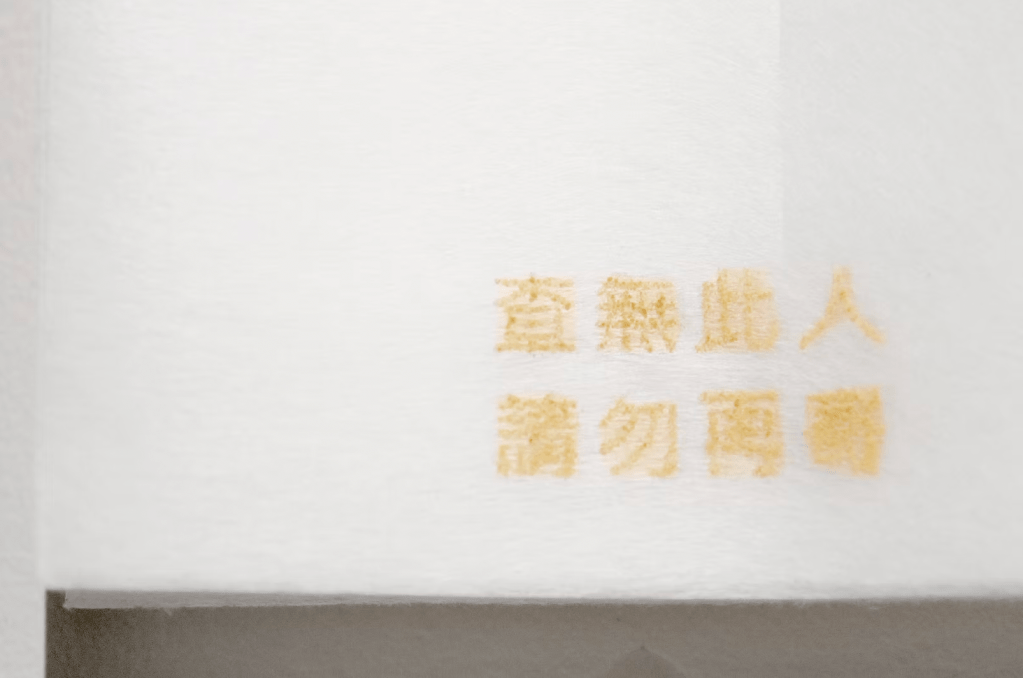
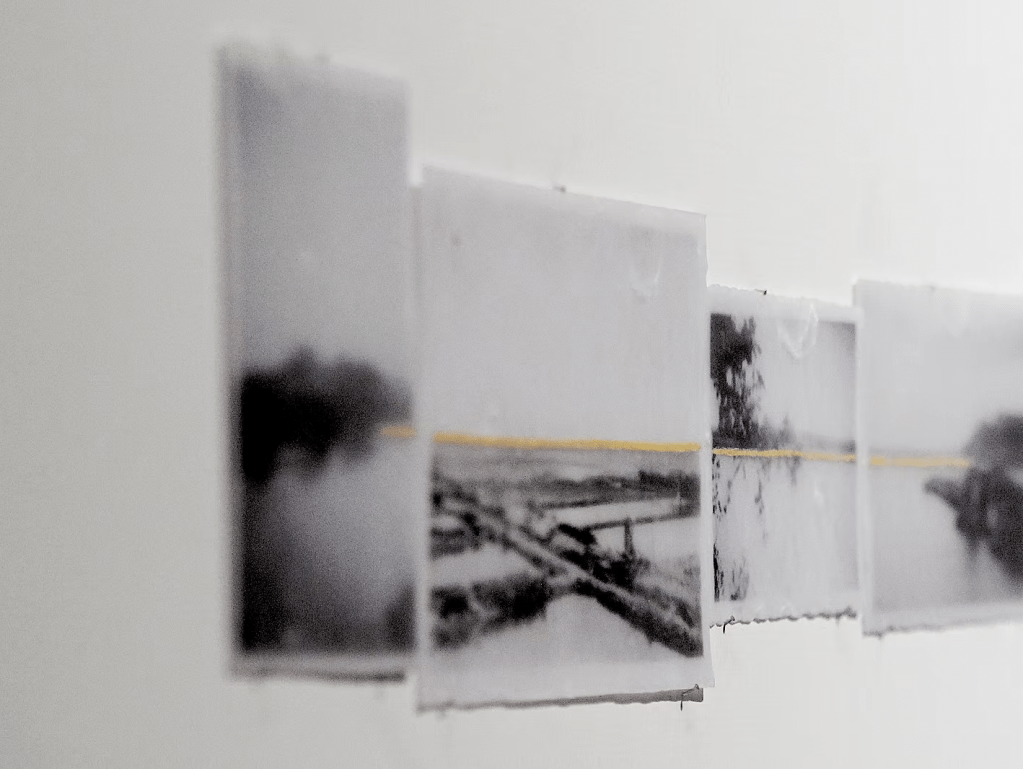
Pollen appears in her works Fragments d’un discours 10 and Être de l’absence 04. In Fragments d’un discours 10, she repeatedly writes “Addressee Unknown” with pollen. In Être de l’absence 04, she selects some gelatin silver prints resembling Taiwanese scenes from a French market and dips them into liquid wax. She then carves into the horizon and inserts pollen into the carved line. She calls these traces “生痕”,(living trace) or the marks of life and existence. They are not symbolic; they are physical traces produced through body movement and experience, like footprints on fallen leaves or impressions in the grass. These traces cannot last forever, nor can they be recreated. The pollen falls, changes colour, and vanishes, like every disappearance in our lives.
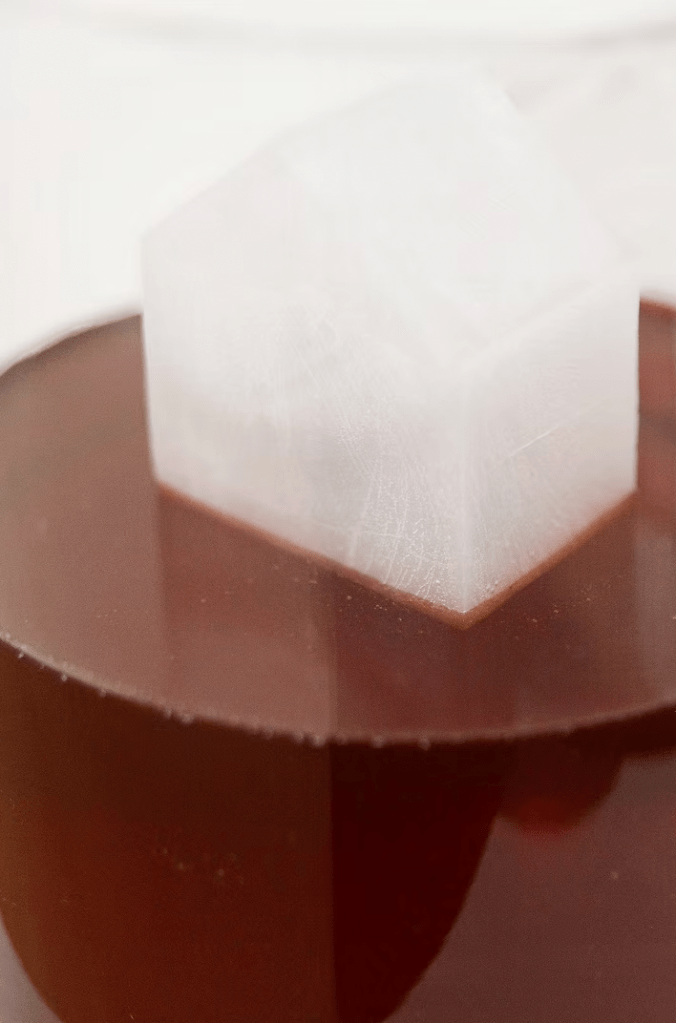
In Mémoire ∙trace 19: En attendant la prochaine vague, CHUANG builds a wax model of her family home. The house sits in the middle of a pond in Luodong, Yilan. Rain and water continue to erode it, and without maintenance it is now too damaged to enter. CHUANG observes the house changing over a decade: it is not yet a ruin, but it is no longer functional. This state of space is not an end, but a process of change, decay, and disappearance.
When no one lives there anymore, the dilapidation of the house becomes a form of absence. Yet this absence is so strong that it almost becomes another mode of presence. CHUANG places the wax house on honey: like the house in memory, it bobs up and down, then slowly sinks. The sinking is irreversible. I ask CHUANG what she feels as she watches it sink.
She wants to save it.
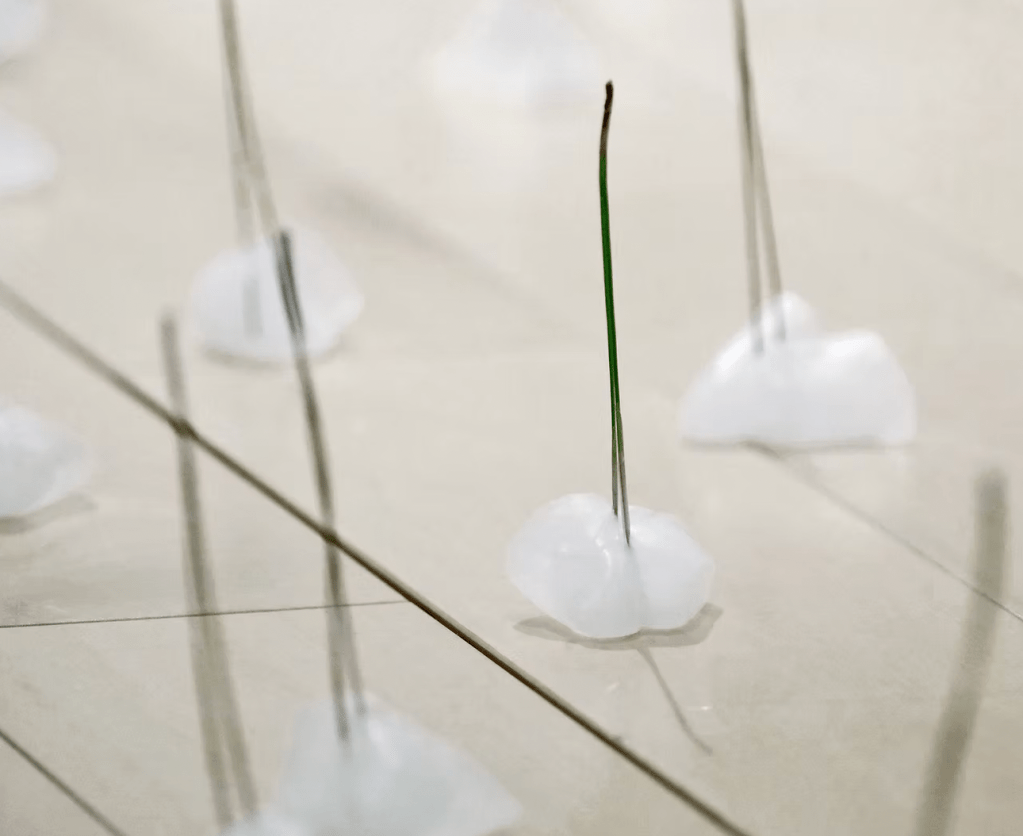
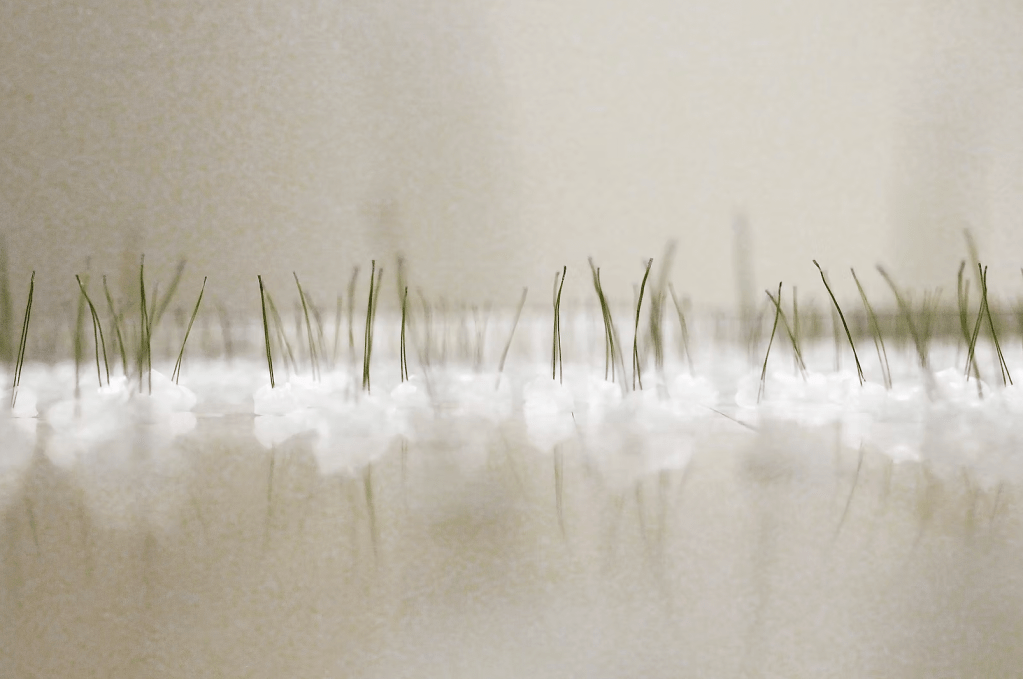
A similar sensation appears in Mémoire trace 15, an onsite installation created in 2023 at Pine Garden, a former Japanese Kamikaze military office. The site is surrounded by Pinus Luchuensis. Each needle splits into two leaves, and when they fall they drop V-shaped, almost like human figures falling upright. CHUANG watches the pine needles keep falling. The movement resembles the descent of kamikaze pilots.
She says that falling always carries a sound, and that sound is painful to her. “Even if there is silence before something hits the ground, that brief silence is itself painful.” To catch the pilots who cannot be caught, and to preserve the painful quiet before impact, she dips her fingers into liquid wax, lifts a pine needle, and fixes it in place before placing it in cold water. When the wax solidifies and her fingers withdraw, their absence becomes visible. The wax forms a shell that seems to hold the pine needle suspended, a gesture at once forceful and heartbreaking.
Hiding is a technique
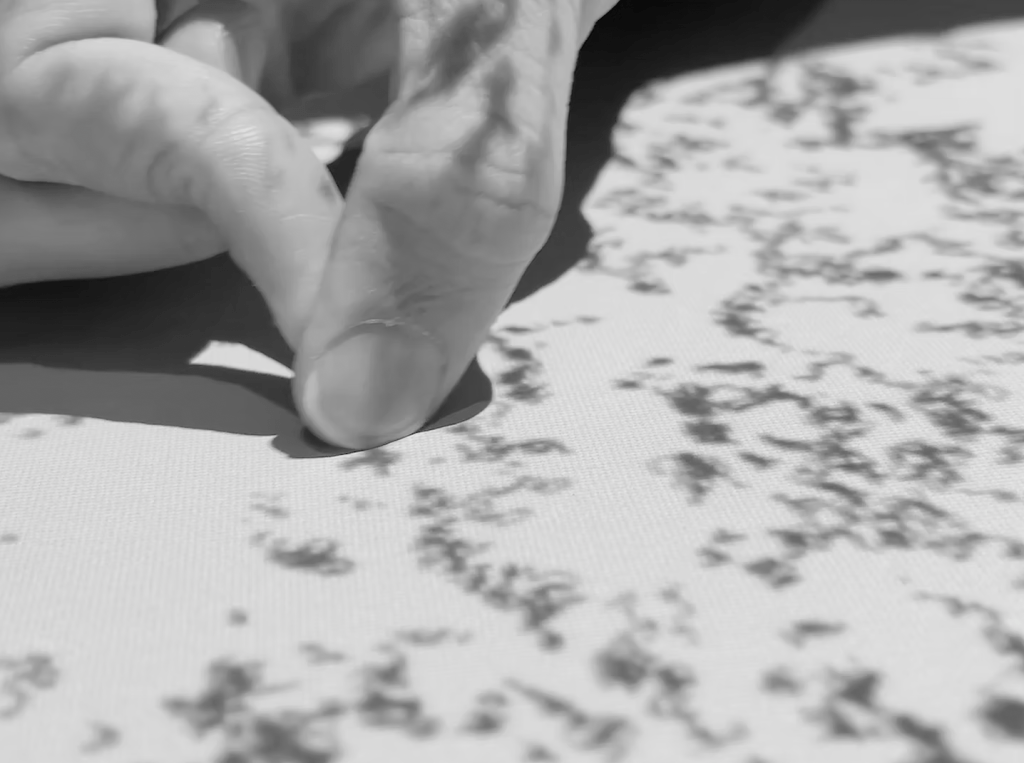
Continuing this tension between presence and absence, LIN Yu-Ta’s painting White follows a similar line of inquiry. He uses nails instead of a pencil to reproduce a photograph from Fernand Deligny’s book. The specific image is not essential, and the scene itself is deliberately nondescript. By scratching the reflected light in the landscape, and repeating the act of copying multiple times, the surface seems to approach blankness. Yet on closer inspection it is not empty. Several streaks of light and reflection remain visible within the incisions. The artist’s method attempts to sustain this process of extension and gradual disappearance.
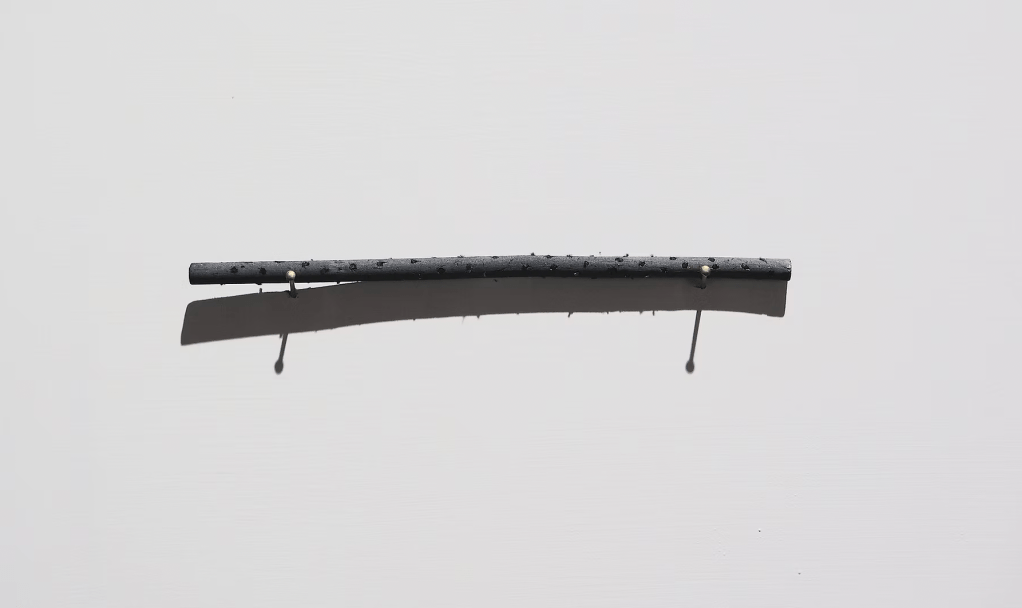
Hocéan looks like a regular charcoal pencil, but actually extends this inquiry and folds back into LIN’s thinking about sketching. He begins by trying to draw the reflection of the sea. Traditionally, reflection is suggested by leaving the paper untouched. But to him, reflection is not emptiness. Emptiness is absence. Reflection is material, present, only slipping past the eye. As he continues to work, a taste of salt suddenly rises in his mouth. The sensation redirects the drawing. He decides that salt itself can stand in for reflection. He grinds black salt into the charcoal and threads the surface. When viewers lean in, light catches on the salt embedded in the marks. The pencil carries not only an image but a sensation. The granular shimmer, and even the imagined taste, edge closer to the unstable surface of the sea’s reflection.
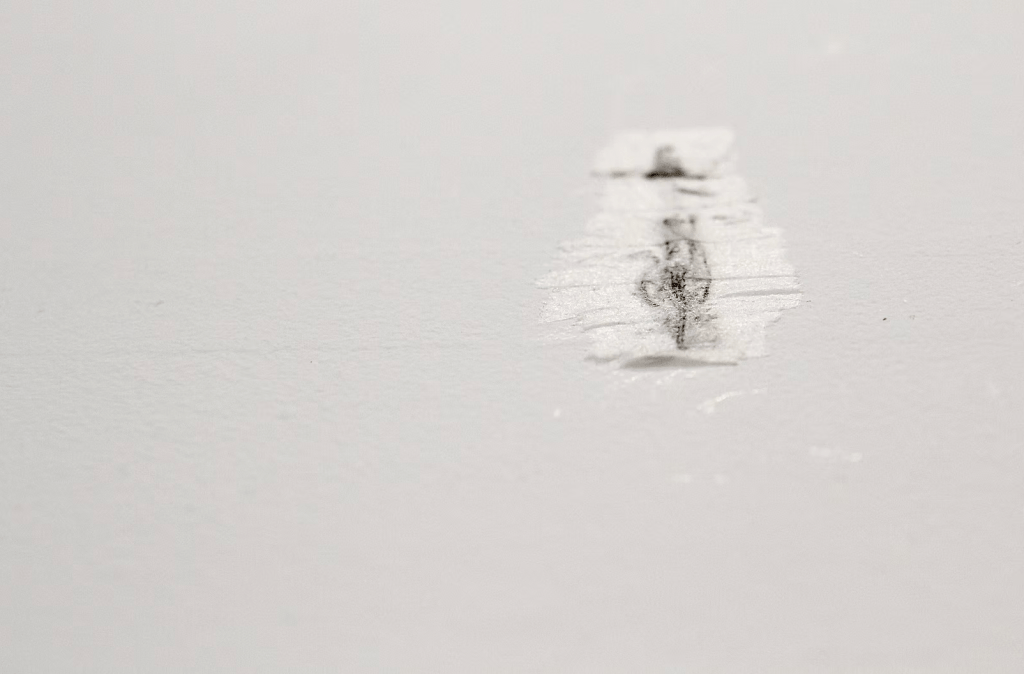
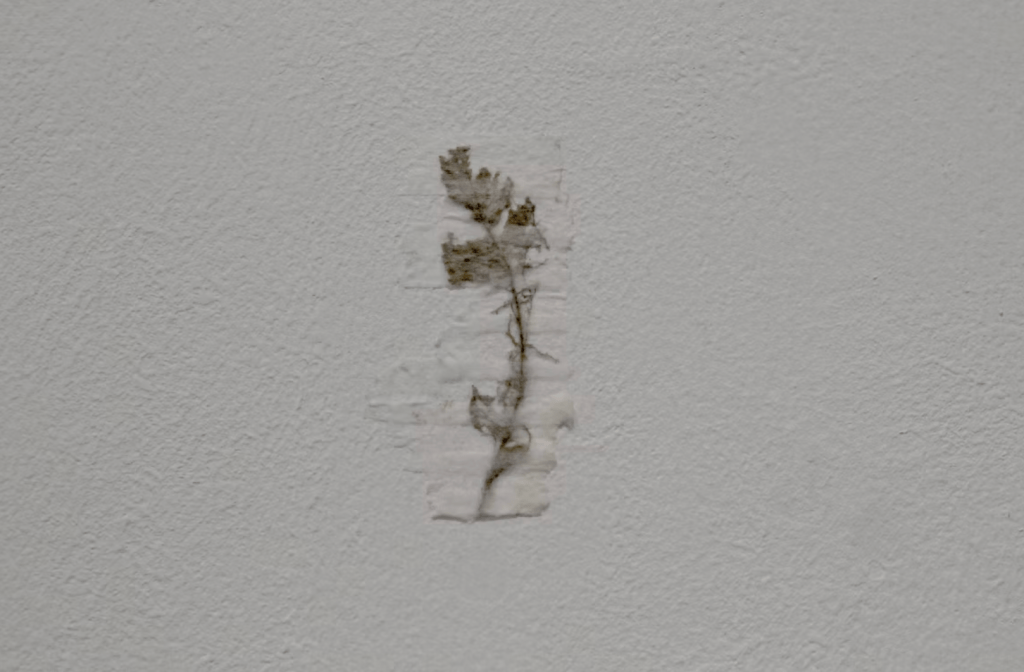
The final work, At a Loss, began in 2014. Ten years ago, LIN collected fallen leaves and twigs along the roadside, securing them in a sketchbook with breathable tape. When the sketchbook was reopened years later, the twigs had long since crumbled into powder, leaving only traces, fragments, and residue. The leaves and branches had lost their volume; only their silhouettes remained, a complete absence.
He mounted the tape on the gallery wall like shrouds, presenting the skins of roadside twigs and leaves. The body of the leaves seems to vanish, leaving only the compressed surface. Yet the textures of the skins, and the very absence they reveal, summon the presence of the original natural forms. In this way, the work responds to the exhibition’s notion of the “interval”: the creative act itself occupies a transition, while the work’s presentation makes this transition visible to the audience. Viewers seem to sketch alongside the artist, attempting to locate remnants. Even as they confront what resembles corporeal remains, the objects still convey a state of in-between, a suspended interval.
Through repeated acts of creation, CHUANG Hsin-Yi and LIN Yu-Ta continue to explore, beyond language, what an interval truly is. When absence occurs, the work assumes another form of presence in the gallery, one that flickers with reflected light, daylight, airflow, and subtle temperature changes – constantly shifting. Absence thus becomes a response: a presence more fluid, less fixed, and more ephemeral than a monument.
 Muainn
發表留言