I-Ying Liu
“A lot of times when I’m making work, there are all these different threads and coincidences. Then at some point, everything clicks. It just happens.”
This is how artist Kuo Yu-Ping describes the origins of her solo exhibition at the NCU Arts Center, titled “What Grows in the Breach of Care.” Years ago, a research project led her to explore Taoyuan’s significance as a symbol of Taiwan’s “city of migrant workers." As time went on, she received an exhibition invitation through which her initial idea could be further explored. Kuo finally decided to fulfill a long-held promise to her family’s migrant caregiver, Linah: to visit her home in Indonesia.
Where Writing Begins
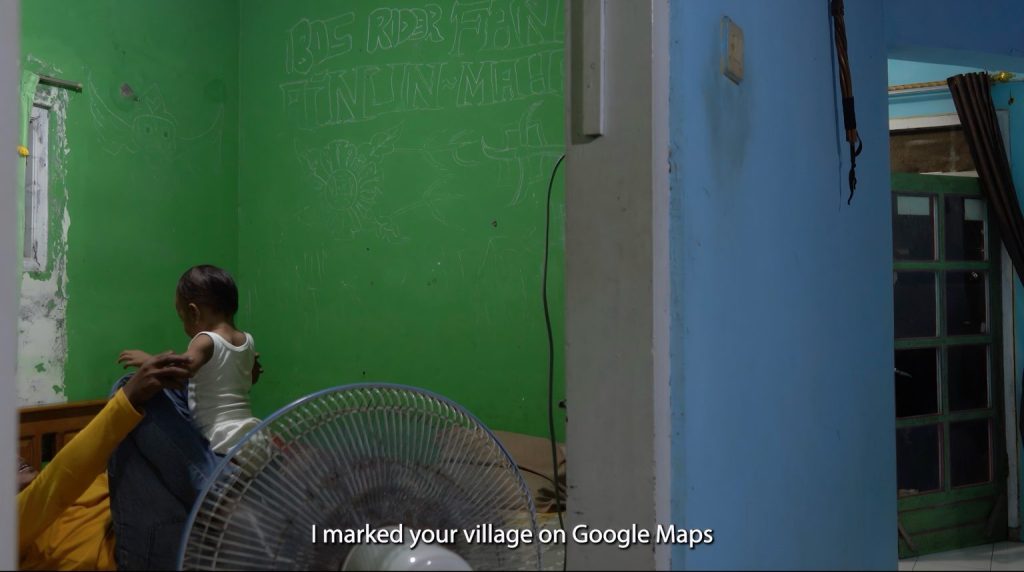
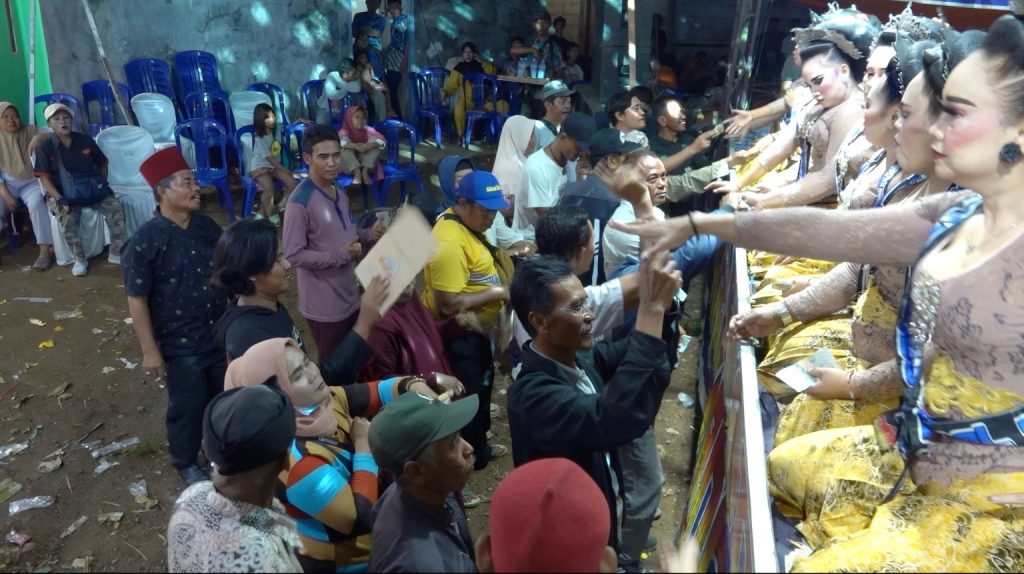
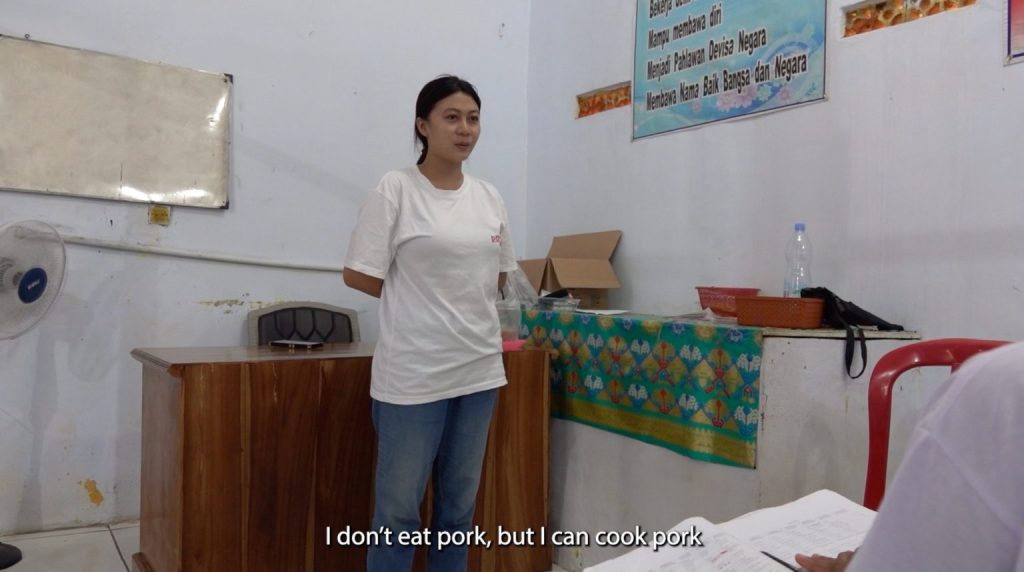
Kuo set off with basic camera equipment. Beyond Linah, she met Tari, another woman who had worked in Taiwan and was then teaching at a migrant worker training center. Driven by an interest in traditional Gamelan music, she also paid a visit to the Sundanese dance troupe Namin Group. These three encounters and the contingencies of the journey pushed Kuo beyond her original plan of producing an installation. Instead, she pivoted toward a video essay, a hybrid of documentary and visual poetry, to embody the subtle, complex, and often indescribable emotions she experienced.
The voiceover, addressing “I” and “you,” evokes the intimacy of a private diary or letters sent across the distance, softly reaching out to Indonesian women living far from home. The narrative moves back and forth in time: from the chaotic traffic when the artist first arrived in Indonesia, to Linah’s six years in Nantou caring for Kuo’s grandfather as he aged and fell ill during the pandemic. It then returns to the present journey, recounting Kuo’s brief time touring with the dance troupe, visiting the training center, and staying in the home Linah built with her earnings as a migrant worker. Interwoven are Linah’s stories of her impoverished upbringing and her labour experiences in Singapore and Taiwan since finishing high school.
Making Visible the Tension of Relationships
Kuo explains that the work takes the form of a video because this medium “better unfolds the layers of thought and emotion." As the primary subject, Linah carries the artist’s contradictory projections of care ethics and self-positioning. The film recounts that even before the pandemic, Taiwan had 260,000 migrant caregivers, highlighting how “hiring foreign help has become a strategy for balancing filial piety and quality of life." The accumulation of caregiving details illustrates how Linah and many others have become “flesh-and-blood proxies for filial piety." Kuo also recalls her own discomfort when they first met: Linah had prepared a meal for the grandfather and the family, but she did not sit at the table with them. The situation left Kuo feeling torn by her multiple roles as a “passive participant and indirect beneficiary of the global care chain." This self-critical complexity became the starting point for her gaze toward Linah.
Another layer of emotional tension surfaced during her stay with the Namin Group. While Kuo was happy to reciprocate their hospitality with food or cigarettes, she felt conflicted when members asked if she could buy a new phone for the leader. She felt guilty for having more resources, yet worried that her generosity might shift the nature of their relationship, turning previous acts of care into something transactional. This blurring of emotions, resources, and boundaries forced her to re-examine her position in cross-cultural interactions.
Kuo notes that in her previous work focusing on new immigrant women, such as her 2018 piece There was no food in my stomach, sun on the back of my neck, love on my mind, panic in my soul, and an ache in my heart., she was already aware of her position of relatively privilege. However, the tension within her relationship with the collaborator was not explicitly addressed in that work. It wasn’t until What Grows in the Breach of Care that she, through the passage of time, gradually found the voice to articulate these complexities. For Kuo, “starting from one’s own perspective" and signaling her subjectivity has always been central to her practice. She once stated: “What an artist records is the path of their own contact with the external world." As her practice evolves, this path is moving toward a deeper and more self-dissecting direction.
As One Thing Evolves into Another
While the narration is woven with care into seven chapters, the visuals retain an organic quality. Kuo selected footage in accordance with the narrative’s unfolding. In scenes depicting the training center’s language and domestic skill classes, visuals and narration are closely synchronized; in some instances, the students’ Chinese-language exercises even supplant the voiceover, underscoring the daily labour invested by local women even before entering the workforce.
The artist deliberately tones down the presence of Linah’s and Tari’s faces, instead incorporating footage of multiple women she encountered during the journey to resonate with Linah’s life story, shedding light on the collective dimension inherent in personal experience. In the opening sequence, the visuals are deliberately decoupled from the voiceover, presenting the traditional Javanese Kuda Lumping dance in a way that resonates with the Suro ritual at the film’s conclusion. Both rituals of exorcism and healing reflect the inevitability and uncertainty inherent in individual fate.
Beyond visuals and voiceover, the artist also gives careful consideration to the use of sound and text. She forgoes the convenience of electronic effects and instead turns to acoustic instruments such as the kalimba, snakeskin drum, and bar chimes to “enhance the emotional texture of the narration.” In one segment, a light, rhythmic drumbeat accompanies a voiceover delivered almost like a résumé, recounting Linah’s successive journeys overseas for work and how these years of labour were translated into concrete walls, doors and windows, a refrigerator, and a television. Her hardship and the tangible support she provided for her family are weighed against each other, exposing an imbalance that resists resolution.
Across the nearly fifty-minute film, the artist replaces the voiceover with on-screen text only twice. The first describes how her grandfather, when feeling unwell late at night, would knock stones against the wall connecting to Linah’s room. The second appears at the film’s conclusion, when Linah takes the artist by boat to a beautiful beach where she once played as a child, only to find scattered remnants of dull, yellowed stones. In the former, text invites the viewer to imagine sound, while in the latter, silence heightens the sense of loss and unmet expectation.
What Makes a Home?
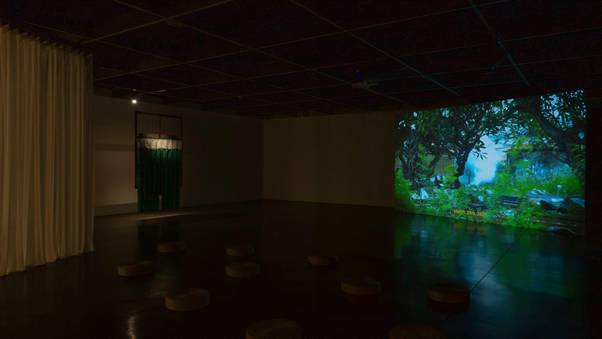
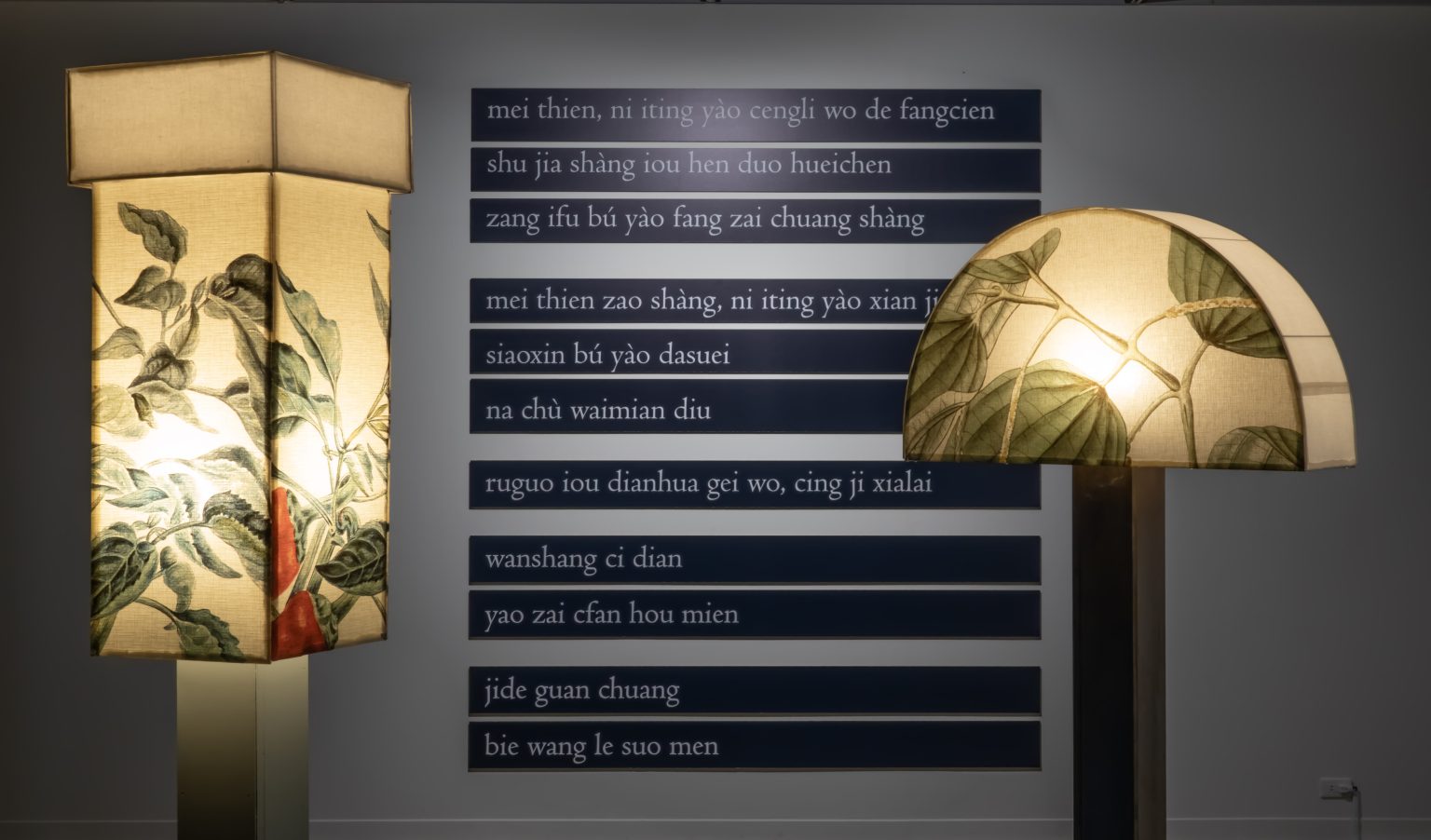
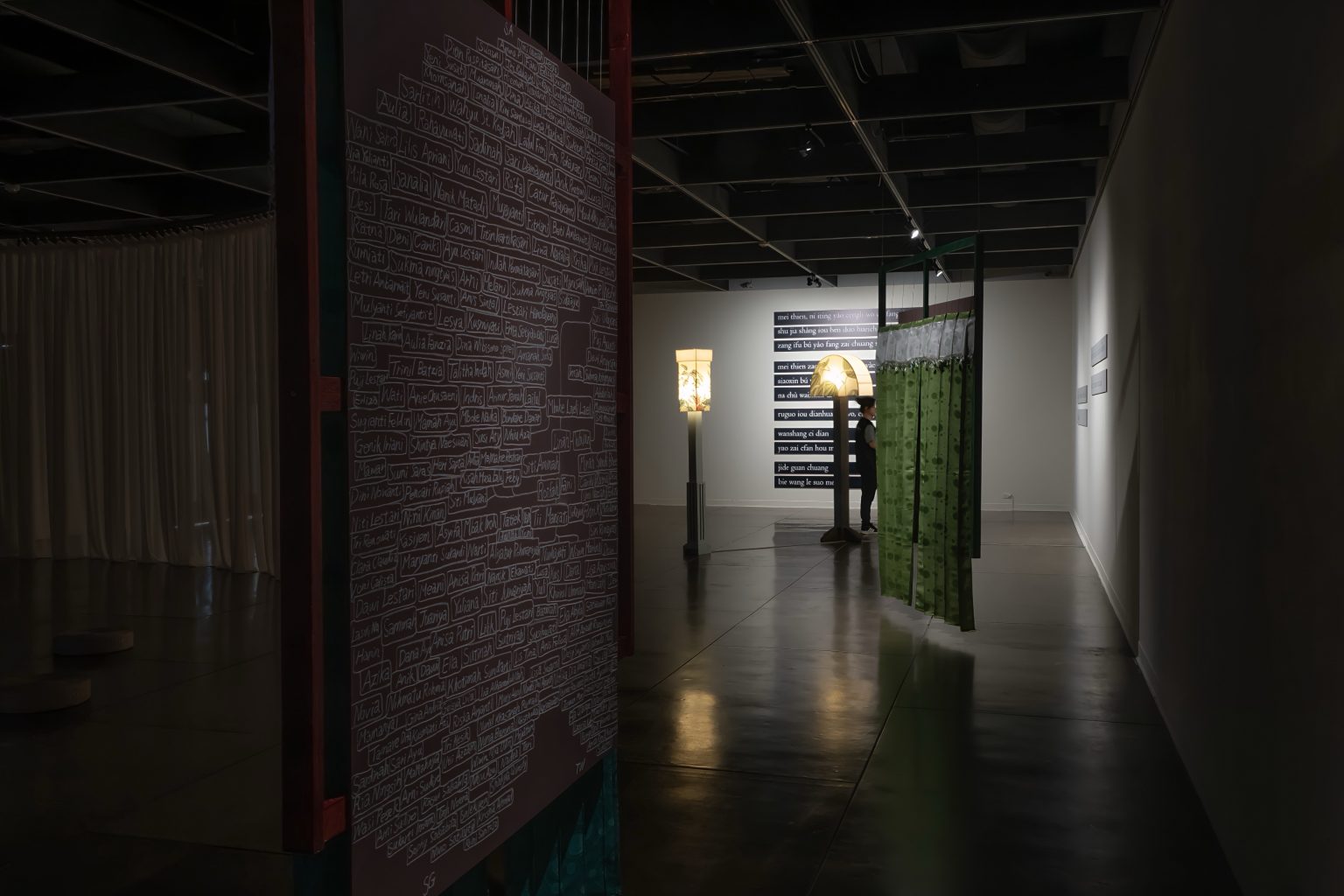
Stepping back from the dense emotions of the video, the other installation elements in the gallery come into focus. Three floor lamps feature patterns of edible plants, pepper, chili, and dragon fruit, selected from Linah’s garden. Two sets of door curtains, sourced from a local market, are among the many gestures of goodwill Linah insisted on offering in return for the filming fee she received from the artist.
Behind the curtains are two charts. One maps the housing relationships in Linah’s village, revealing that the more modern homes were built by women working abroad for years. The other chart lists the full names of all current students at the training centre, grouped according to their future destinations. Kuo noted that labour agencies often simplify or change caregivers’ names for the employer’s convenience. By writing their full names and destinations, she honors these women who spend their youth caring for others’ children and elders while their own identities are often erased.
On another wall are several phrases written in Roman letters that even native Chinese speakers must strain to piece together: “You must clean my room every day,” “Do not leave dirty clothes on the bed,” “Be careful not to break it,” “Remember to close the window.” At first glance, they resemble a mother’s careful reminders about a child’s daily habits. Only in relation to the video does it become clear that these are phrases migrant women are required to learn to understand at the training center. The boundary between care and command blurs, while the power relation remains fixed, making clear who the home ultimately belongs to.
When asked about the exhibition title, Kuo recalls that its Chinese version, “If it passes through the strong acid of time,” comes from Chariots of Women, a poetry collection by Amang, which reflects on motherhood. She felt that the years spent as a migrant caregiver are, in their own way, also a form of “strong acid." Through their daily conversations, Linah shared many difficult experiences. While Kuo does not recount every specific incident, she chose to expand the film to fully convey Linah’s life and labor history. As the narration says: “Linah is the love of care, a name both intimate and fleeting, flowing across borders.” In this instance, it is Kuo, a relative of the cared-for, who crosses the ocean to find her. Their brief time together not only becomes a mirror for Kuo’s own reflections but also allows her to depict Linah not just as a labourer but as an individual, and through her, to trace the contours of a broader portrait of female migrant workers.
*This text was originally published in 可口雜誌 Cacaomag (中文版).
*Supported by the National Culture and Arts Foundation and the Wenxin Arts Foundation through the “Visual Arts Criticism Project.”
 Muainn
發表留言